
On this page
Health disclaimer: This page is general information, not medical advice. It does not diagnose, treat or replace your doctor. Talk to a doctor or pharmacist before you change medicines, start supplements or begin a new training programme, especially if you have a health condition, take medication, or are pregnant.
Many adults who decide to "get serious" make the same mistake: they do too much, too soon, and stop after a few weeks because they are sore, tired or injured. A better plan is boring on paper and works in real life: a little strength, a little balance, a few short hard efforts and a lot of easy movement – with proper rest in between.
What the guidelines say
The 2018 Physical Activity Guidelines for Americans (2nd edition) say adults need:
- At least 150 to 300 minutes of moderate-intensity aerobic activity a week, such as brisk walking or fast dancing.
- Muscle-strengthening activity on at least 2 days a week, such as lifting weights or doing push-ups.
- To move more and sit less. The guidelines' first key message for adults is based on evidence linking sedentary behaviour to higher risk of heart disease, high blood pressure and all-cause mortality.
The same guidelines note that physical activity has immediate benefits, such as reduced anxiety, and that for older adults it lowers the risk of falls and injuries from falls. The WHO fact sheet on physical activity uses the same 150-minute baseline in its global recommendations.
Strength: twice a week is the foundation
Strength training keeps you able to carry shopping, climb stairs and get up from the floor. Two sessions a week of 20–40 minutes is enough to start. Choose a handful of movements that cover the whole body – a squat or sit-to-stand, a push (push-ups against a wall or bench), a pull (rows with a band), a hip hinge and a carry. Stop each set while you could still do a couple more good repetitions.
Balance: the overlooked skill
Balance is trained like anything else: by practising it. Simple options are standing on one leg while you brush your teeth, walking heel-to-toe along a line, or slow step-ups. Keep something to hold on to nearby. Because physical activity lowers the risk of falls in older adults, balance work is a sensible add-on as the years go by.
Cardio: short intervals and lots of easy
You don't need long, exhausting sessions. One or two short interval sessions a week, built on top of easy walking, cycling or jogging, can be enough for most people who want to improve. Free, ready-made sessions on vo2max.io:
- Norwegian 4×4 – four hard four-minute efforts with active recovery.
- 30/30 intervals – 30 seconds hard, 30 seconds easy; a friendly way to start.
- Tabata timer – very short, very hard; best once you have a base.
- HIIT twice a week – how to fit two sessions into a normal week.
- 8-week VO₂ max training plan – a structured plan if you like to follow a schedule.
Most of your weekly minutes should still be easy enough to talk in full sentences.
Why more is not always better
Exercise is one of the best things you can do for your health – and for most people, the problem is doing too little, not too much. But the research also suggests that endless volume is not the goal.
Lifespan: moderate already gets you most of the way. A pooled analysis of 661,137 adults (Arem et al., 2015) found that people meeting the minimum activity guideline had a 31% lower risk of death than inactive people. The benefit levelled off at about 3–5 times the minimum, and compared with simply meeting the guideline the extra gain was modest. A 30-year study of 116,221 US adults (Lee et al., 2022) found the near-maximum association with lower mortality at about 150–300 minutes a week of vigorous or 300–600 minutes of moderate activity; higher amounts did not clearly add further benefit. Importantly, neither study found that very high amounts shortened life – Arem et al. saw no evidence of harm even at 10 or more times the minimum. More simply did not buy extra years.
The heart rhythm: atrial fibrillation. Atrial fibrillation (AF) is an irregular heart rhythm. Two meta-analyses found it is more common in athletes than in non-athletes: Abdulla & Nielsen (2009), pooling six case-control studies of mostly middle-aged men, reported an odds ratio of about 5.3; Newman et al. (2021), a larger and more recent review, reported an odds ratio of about 2.5. In other words, the studies point to roughly 2.5 to 5 times higher odds. These are associations in athletes with many years of training, not proof that exercise causes AF, and the absolute risk for an individual is still modest.
Scarring in the heart muscle. In a study of 152 lifelong masters endurance athletes (average 31 years of training, most of them runners with a median of 13 marathons), Merghani et al. (2017) found that 14% of the male athletes but none of the sedentary controls showed late gadolinium enhancement on heart MRI – a sign of scarring (fibrosis) in the heart muscle. The male athletes also had more coronary plaques, though mostly of a calcified, stable type. The authors stressed that the significance of these findings is uncertain.
What this means in practice. None of this is a reason to stop training. It is a reason to train smart: get most of your benefit from a moderate weekly amount, use short intervals with plenty of rest instead of grinding out ever-longer sessions, and spend the time you save on strength and balance, which protect your ability to move well as you age. Recovery is where the body adapts, so:
- Keep at least one easy day between hard interval sessions.
- Increase volume or intensity gradually, one thing at a time.
- Plan a lighter week every few weeks, and treat sleep as part of the programme.
- If you notice palpitations, an irregular pulse, chest pain, fainting or unusual breathlessness, stop and see a doctor.
A sample week (adjust to your life)
- Monday: strength, 30 minutes.
- Tuesday: easy walk or ride, 30–45 minutes, plus 5 minutes of balance.
- Wednesday: 30/30 or 4×4 intervals.
- Thursday: rest or gentle walk.
- Friday: strength, 30 minutes, plus balance.
- Saturday: longer easy walk, run or ride.
- Sunday: rest.
Measure your starting point with the biological age calculator, follow the plan for eight to twelve weeks and test again. Food matters too – see Food – and so do your blood values (Biochemistry and values).
FAQ
How much exercise do I need? The 2018 US guidelines recommend at least 150–300 minutes of moderate aerobic activity a week and strength training on at least 2 days.
Are short intervals enough? They are a time-efficient way to add hard work, but the guidelines' weekly totals still apply. Combine intervals with easy movement.
How often can I do intervals? For most people, one or two sessions a week with easy days in between is a sensible start.
I'm over 60 – should I train balance? Physical activity lowers the risk of falls in older adults. Check with your doctor first if you have health issues.
Is a lot of endurance training bad for the heart? Meta-analyses link many years of endurance sport to roughly 2.5–5 times higher odds of atrial fibrillation, and one study found heart-muscle scarring in some veteran male athletes. Studies have not shown that it shortens life; it just doesn't add extra years beyond a moderate amount.
How do I know if I'm overdoing it? Persistent fatigue, worse sleep, nagging aches and dropping performance are common signs. Take more rest and talk to a professional if it continues.
Full disclaimer
This page is general information, not medical or physiotherapy advice. Get clearance from your doctor before starting hard or interval training, especially if you have heart, lung, metabolic or joint conditions, are pregnant, or have been inactive. Stop immediately and seek medical help if you experience chest pain, dizziness, fainting or unusual shortness of breath. Coaching covers training programmes and follow-up only and is not medical care. Sources were checked in October 2026.
Sources
- US HHS – Physical Activity Guidelines for Americans, 2nd edition (2018), Top 10 things to know: https://health.gov/our-work/nutrition-physical-activity/physical-activity-guidelines/current-guidelines/top-10-things-know
- WHO – Physical activity fact sheet: https://www.who.int/news-room/fact-sheets/detail/physical-activity
- Arem H et al. Leisure time physical activity and mortality: a detailed pooled analysis of the dose-response relationship. JAMA Intern Med. 2015;175(6):959-67. https://doi.org/10.1001/jamainternmed.2015.0533
- Lee DH et al. Long-term leisure-time physical activity intensity and all-cause and cause-specific mortality. Circulation. 2022;146(7):523-534. https://doi.org/10.1161/CIRCULATIONAHA.121.058162
- Abdulla J, Nielsen JR. Is the risk of atrial fibrillation higher in athletes than in the general population? A systematic review and meta-analysis. Europace. 2009;11(9):1156-9. https://doi.org/10.1093/europace/eup197
- Newman W et al. Risk of atrial fibrillation in athletes: a systematic review and meta-analysis. Br J Sports Med. 2021;55(21):1233-1238. https://doi.org/10.1136/bjsports-2021-103994
- Merghani A et al. Prevalence of subclinical coronary artery disease in masters endurance athletes with a low atherosclerotic risk profile. Circulation. 2017;136(2):126-137. https://doi.org/10.1161/CIRCULATIONAHA.116.026964
- vo2max.io workouts (linked above)
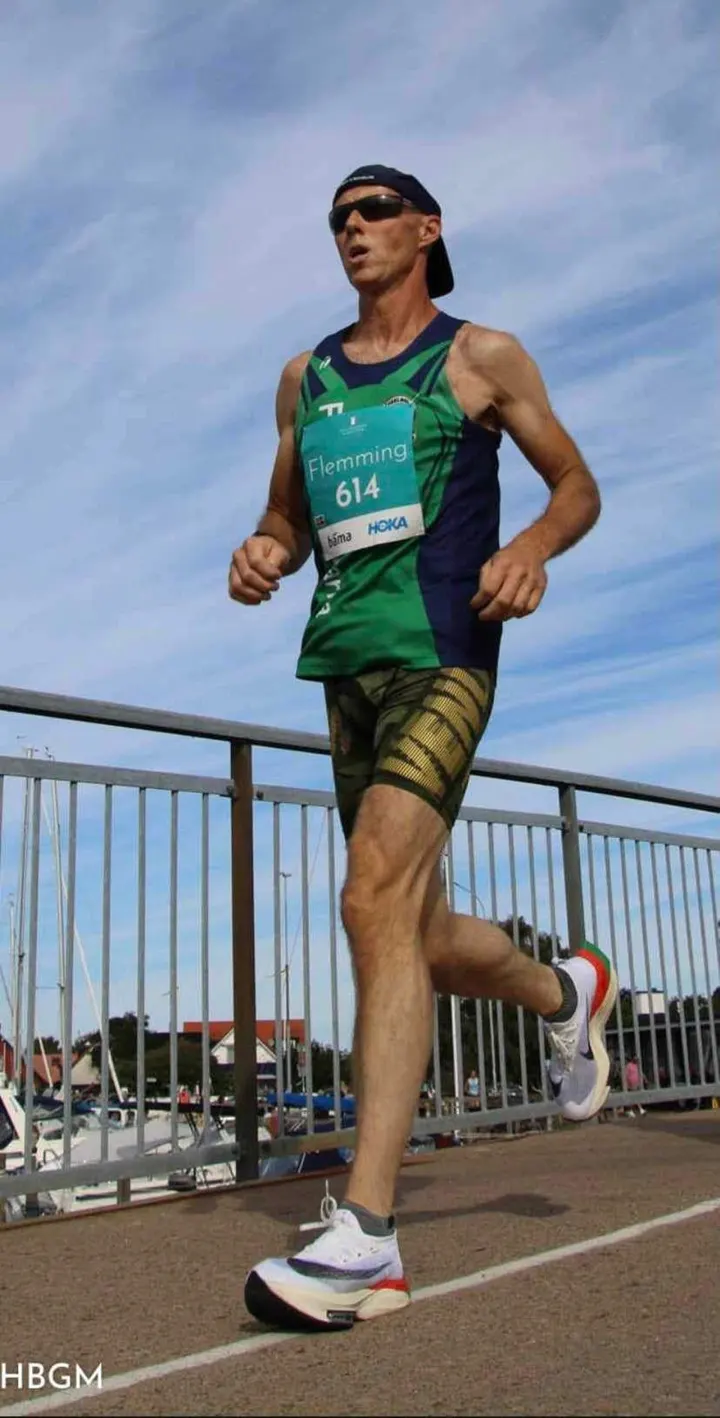
Former elite cyclist, master runner over 5000 m and 10 000 m.
Coaching with Flemming
A training plan with weekly follow-up
Running or cycling. I look at every session you log. First month free, no binding period, via Everfit.
$45 / £45 per month